
The deck was good and the references checked out. The dude running the call knew what a QBR was and used your CEO's first name twice without making it weird, and on Friday you are going to send his company a deposit large enough that finance will ask you about it specifically.
Nobody on your side has asked whether his company is a registered travel agency.
Not whether they do travel. Everyone does travel. Whether they are an accredited agency, with a valid number, on the registry the airlines keep.
There is a secret list…
The existence of this list surprises people, which makes it worth knowing about.
Airlines have spent a long time working out who is allowed to manage other people's airfare. Their answer is logged in a global registry. The entries are eight digits long; ours is 36567215 (wink wink).
Getting on it is tedious in a way that turns out to be the entire point. IATAN's requirements for a US agency read less like an application than like an inventory of the ways a travel company can fail:
- Two years in the trade, proven by a reference letter from somebody already on the list.
- Your books opened to the IATAN auditors.
- $10,000 in real capital if you are new, or working out of your mom’s spare room.
- Professional liability insurance, or sufficient years of experience offered in its place.
- Registration with the few US states that bothered to pass a law about it.
Nowhere does the application ask whether you have taste. They don’t care whether your offsites will be any good.
That’s fine. It’s not that kind of test. It establishes that you are a serious person running a serious company (i.e. that you can be trusted with other people's money for a living). It was written by people who had met the alternative.
What that 8-digit number does
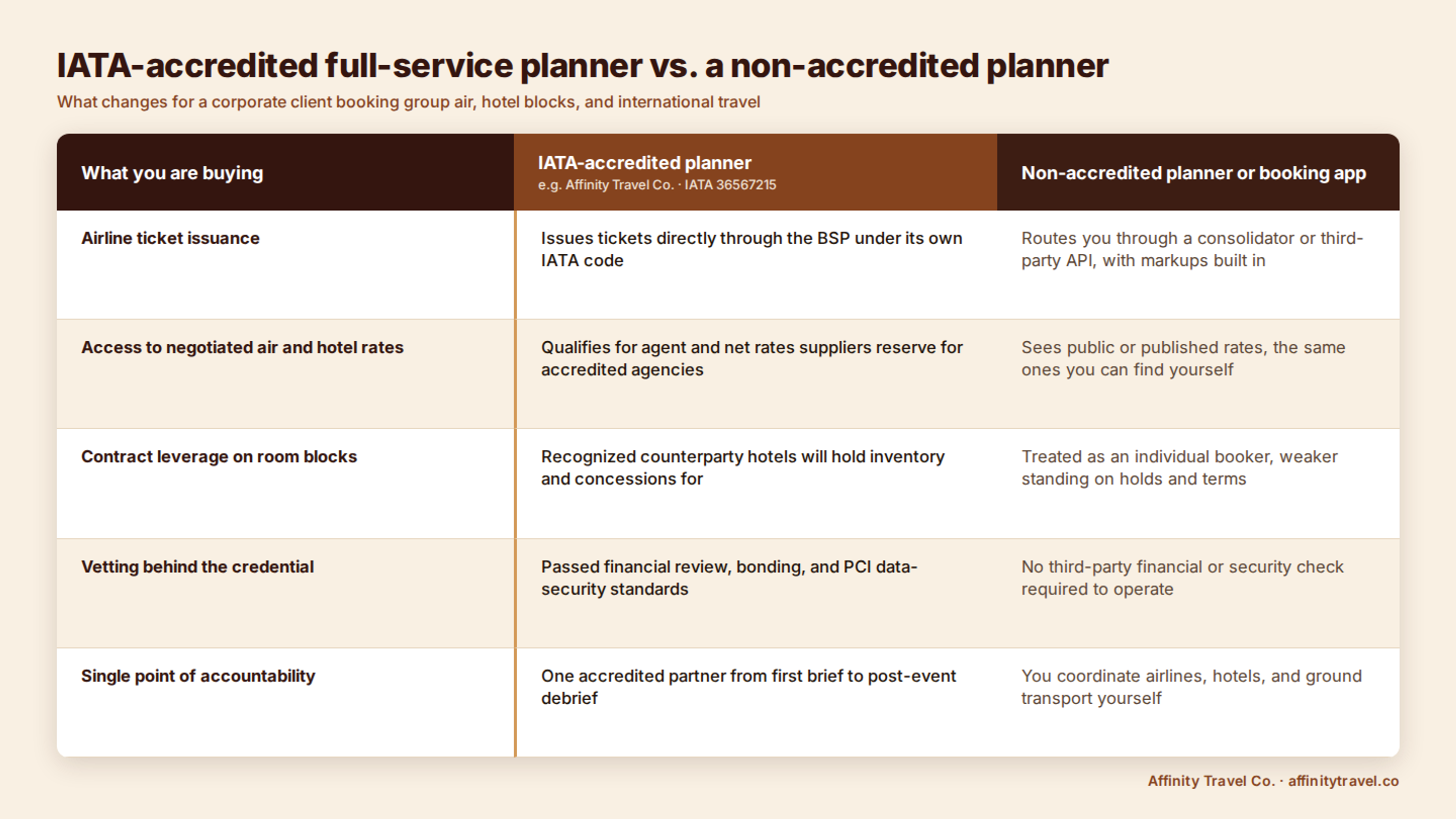
IATA accreditation makes you an agency. A second approval, this one from ARC, makes you an agency that can write the ticket itself, on airline stock, and settle it through the clearing system the airlines already use. Most buyers hear the first and assume the second.
The difference will bite you in early January, three weeks before your sales kickoff over MLK weekend, when some key sales reps resign.
There are 200 names on that rooming list and it’s now wrong. An agency holding ticketing authority reissues the seat. A company that bought 200 fares the same way you buy one rebooks at whatever this morning's price happens to be, and then does it again in February when somebody else leaves. On a program that size the gap between those two outcomes is bigger than your bonus.
Standing is the other half of it. A hotel negotiating a 200-room block wants to know who is on the far side of the table. An accredited agency arrives carrying a code that the hotel's own systems already recognize, which is why the concessions conversation starts somewhere different, and why the attrition clause turns out to be negotiable.
The part that shows up at 2am
Crappy domestic travel experiences have some room to be forgiven. A missed connection in Denver is a bad afternoon.
Now consider 40 people on four airlines to a country where none of them speak the language. Then the second leg cancels while half the group is still in the air. Somebody has to reissue tickets with an airline that has no obligation to you, at an hour when the account manager at a booking platform is asleep and was never going to be able to do it anyway.
That hour is what the accreditation is for. To stop your offsite from jumping out of the frying pan and into the fryer.
How few of the people pitching you hold it
The offsite industry filled up with platforms, marketplaces and tech-enabled planners, and a great many of them are excellent at the pitch. They are software companies that touch travel. When something goes wrong at 2am they are calling the same hotel you could have called yourself.
It’s cheap to check. An accredited agency knows its number the way you know your own phone number. It belongs in the RFP response next to the insurance, not produced later on request.
The state registries are the other half of the same check. They cost nothing. California publishes a Seller of Travel search that anybody can uses. Affinity Travel Co. is California Seller of Travel 2166658-50 and Florida Seller of Travel 46000. Look them up while you are still on the call.
Three questions, and the answers worth hearing
"What is your IATA number, and are you approved to issue tickets?" The answer is eight digits and a yes or a no. "We're IATA accredited," delivered smoothly and without the digits, is a different answer than it sounds like.
"Do you carry errors and omissions cover, or did you take the waiver?" Accreditation accepts two years of experience in place of a policy, so the logo does not settle it. Ask for the declaration pages of their policies. General liability covers a slip in the lobby. E&O covers the booking mistake that leaves 11 people in the wrong city.
"Who is on the ground with us?" A name, a role, an arrival time. "Our team will be there" is not a name.
What you are actually buying
The IATA number does not promise the offsite will be good.
It promises there is a company behind it, audited and insured and listed, answerable to an industry that has seen every way this goes wrong. On a Tuesday in a foreign airport with 40 people looking at you expectantly, that turns out to be most of what you need.
Affinity Travel Co. is a single partner that plans and executes corporate offsites, executive retreats and sales kickoffs for groups of 10 to 500, booking and managing every vendor from venue and air to private dining and ground transport, with staff on site for the program. We have run 30+ programs across 28 countries for 900+ guests. If you want the buyer's version of this question, our guide to what an IATA license gets you when you hire a group travel partner covers what to ask on the call, and why corporate offsites fail covers the ways a program comes apart once the travel is handled. Read more about how we run corporate offsites and sales kickoffs, or request a proposal (it’s free!).
Frequently asked questions
What does IATA accredited mean for a corporate travel agency?
Is an IATA license the same as IATA accreditation?
Does an IATA accredited agency have to be bonded?
How do I check whether a planner is an accredited agency?