Someone’s AI agent put a 3 day hold on 11 exec calendars for the second week of April. So far the only thing written down is a country name: Retreat in Bermuda.
You're about to take the people who set direction for everyone else and remove them from their jobs for most of a week. Your instinct is probably to cram every hour full, because an empty block on a calendar that expensive seems wasteful.
Fight the instinct! Gallup found that managers account for at least 70% of the variance in employee engagement across business units, so your 11 are the ones who move that number for everybody else.
They don't need a conference. They need 3 days of focus time together, because their calendars somehow never align, except for the leadership team meeting.
An executive retreat is a different animal from a company offsite. A 60 person offsite is built for agreement and momentum among people who already work together. A retreat for 11 exists to settle 2 or 3 key decisions no one else can make.
Set the outcome before you hold the dates
What happens if your first session opens with "so, what are we hoping to get out of this?" You've wasted a day on a question a short email could have settled (don’t be like that!). Worse, if you brought along GMs or key managers, you've shown them you don’t have a plan, which is a stupid thing to broadcast to the folks running your business units.
Here’s an example of the email you need to send 1.5 months in advance:
Subject: the one decision we're making in March
After our retreat, we need to leave one answer: which 2 of our 6 markets get priority on next year's hiring budget, and what the other 4 do without less.
Each of you owns a session. They’re all on the calendar with directly responsible individuals. Be ready to present what's working and what isn't, in 20 minutes or less. Slides optional, candor required.
I’ll send the pre-read on March 1; read and come ready to debate.
Then work backward from that paragraph. Our offsite planning framework runs the same sequence at company scale. The order of operations is the trick to better results: outcome, then agenda, then dates, then venue.
Run it in reverse and your sessions feel arbitrary, because they are. That reversal is the first failure mode in our guide to why corporate offsites fail.
Four things to write beforehand:
- The one or two outcomes, a sentence each, 6 weeks out.
- A named owner for every working session, a month out.
- The pre-read, sent 10 days ahead, kept as concise as possible.
- How you'll know at 90 days whether it worked, decided now rather than afterward, so no one moves the goalposts.
The 30/40/30 split
Once your outcome is written the agenda mostly designs itself: 30% structured work, 40% meals and social, 30% with nothing in it at all.
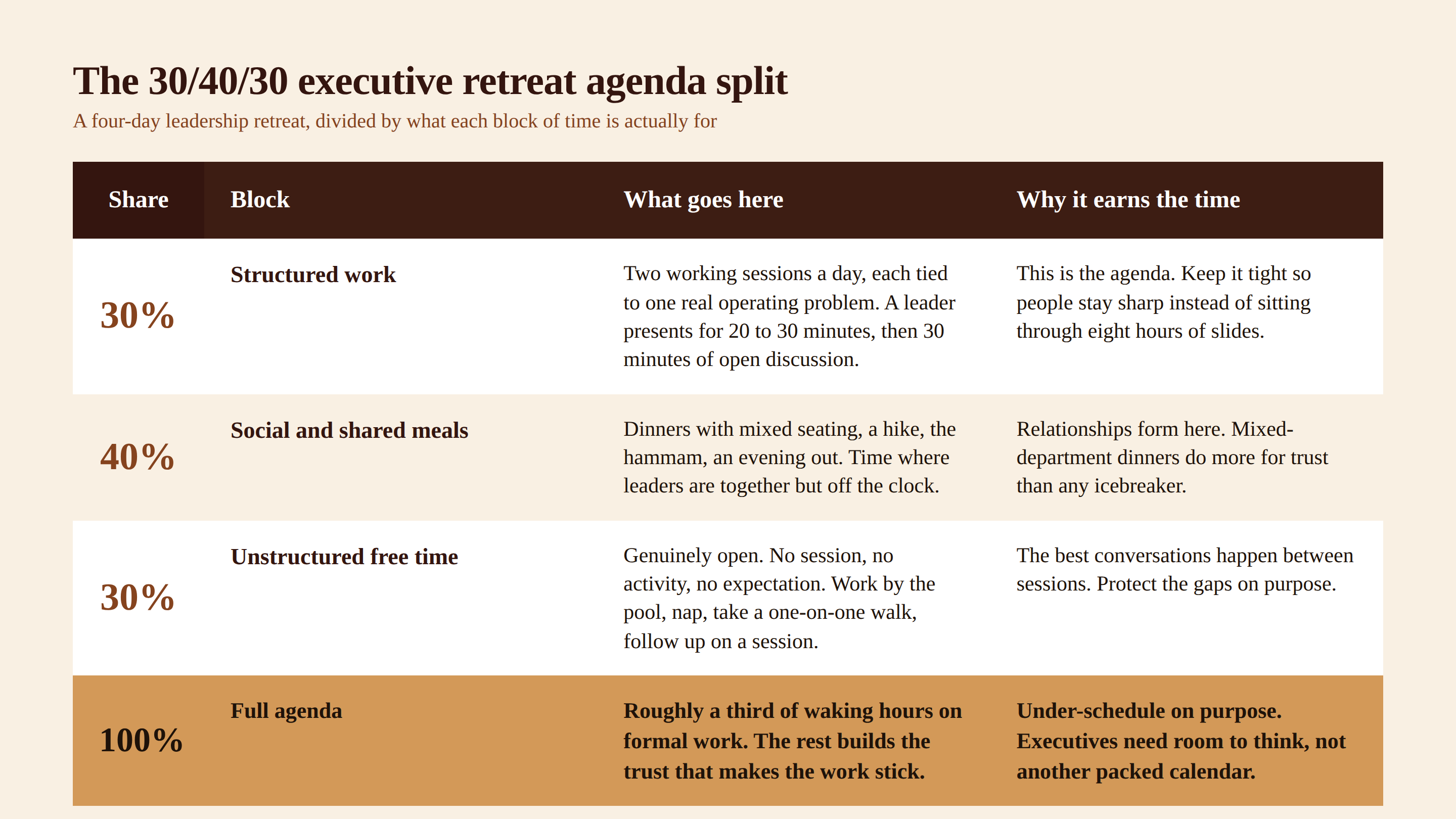
The structured 30% is smaller than feels defensible. Two working sessions a day, no more. Past that the room stops absorbing and starts enduring, which you can watch happen from the front of it.
The social 40% isn't the reward for the work. It's a second working format, which is why seating is assigned and reshuffled at every meal. Your head of sales sits next to your head of engineering whether or not either would have chosen it.
The unstructured 30% is the line finance will ask about. It's also the one that pays for the trip.
Why? Because that's the block where your US East general manager corners your LatAm one about some pricing thing neither wanted to raise in front of the chief executive. You can't schedule that conversation. Instead, leave a timing hole for it and then get out of the way.
Three days, block by block
Move the hours to suit your flights. Keep the proportions.
Day one is travel, plus exactly one session.
- 4:00 pm. Everybody on property. Nothing before this, because one flight is always late.
- 5:30 to 6:30 pm. Your only whole-group session of the trip. The chief executive names the decision to make and the 2 big questions underneath it. Produces: reaffirmation of the goal.
- 7:30 pm. Dinner, one table, seating assigned. Produces: icebreaker.
Day two is the work.
- 9:00 to 10:15. Session one. 20 minutes from the leader who can best respond to the question, then 55 minutes of the others taking it apart. Produces: a written list of what to scale and what to fix, with a responsible person against each line.
- 10:15 to 12:30. Empty. Let people self-organize.
- 12:30 to 2:00. Lunch outdoors, if possible.
- 2:00 to 3:15. Session two, same format, different leader, same written output.
- 3:15 to 7:30. Empty again. This is the block you'll probably be lobbied to fill.
- 7:30 pm. Dinner off property, tables of 4, seating reshuffled from the prior meal.
Day three is the decision, then the airport.
- 9:00 to 10:30. The decision itself, in the room, with the numbers on the wall. If it isn't reached by 10:30 your chief executive makes it and says so.
- 10:30 to 11:15. Every person writes one thing they'll do differently in their own department within the next 30 days, with a target date on it, then reads it aloud. Discuss. 11 sentences, 45 minutes.
- 11:15. Done. Book departures after 2:00 pm so no one spends the last session watching a clock.
The results of a well-run working session
The format never changes, which is how you can run 2 per day without hiring a facilitator.
One leader presents. Pick whoever knows or operates within the question area the best, rather than whoever has the most senior title. 20 minutes on what they did last quarter, with the numbers. Then 55 minutes in which everyone else may ask anything.
Three rules hold the format together.
- Nothing abstract goes in the 20 minutes: if your leader didn't do it last quarter, it isn't a session.
- Somebody other than the presenter writes the list of to-scale and to-fix.
- And your chief executive always speaks last or the room converges on whatever they say.
Do you need an outside facilitator? Only where you expect a real fight, which for most leadership groups means the budget session. If the retreat follows a reorganization the room may be tense, so read our playbook for a leadership retreat after a reorg first.
Make the destination work for you
Domestic is easier to book. For a group this small international is often the better call, because the reason to travel at all is psychological rather than logistical.
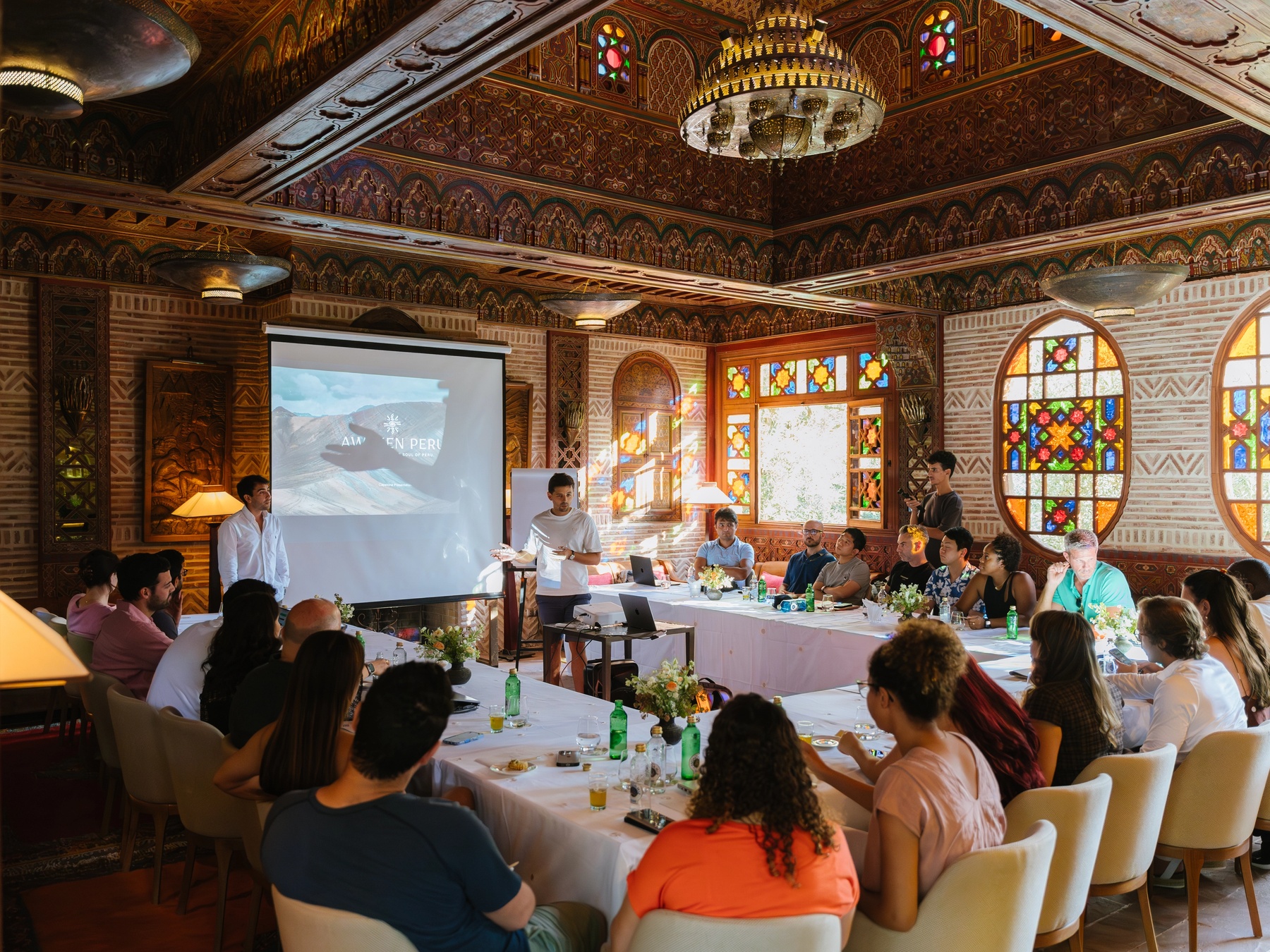
Here’s an example: a holding company with general managers in 12 countries had no reason to meet in an airport hotel. Their leadership retreat ran in Morocco's Atlas Mountains, in a resort taken over for the group, and every session was led by a general manager rather than by the executive team. They left with 34 practices and experiments they meant to try, written down, with DRI names against them.
The setting did a second thing that never makes it into a plan. These were travel executives who spend their working lives building experiences for other people and almost never get to be inside one. An hour in the hammam (spa) between sessions isn't an indulgence on a trip like this.
A leadership retreat isn’t just a place to debate. It’s allowed to be a reward.
What does it cost you? More moving parts: flights out of 12 countries, visas, a privatized villa with no sales office, ground transport on roads your rideshare app has never heard of, dietary needs that are hard to manage in a mountain range.
Who does the booking while you do the thinking?
All of the above is the easy part. The hard part is that somebody has to manage 11 itineraries out of 9 airports, argue a resort down from a 3 night minimum, and take the 6am call when a connection through Casablanca cancels.
At a company your size the work lands on your chief of staff or executive assistant, who is also the person you asked to capture the decision and write the to-scale list. One of those two jobs loses. Somehow, the more important work falls through the cracks so they can chase people on the phone.
Is that worth paying somebody else for? Gallup puts the gap between its most and least engaged business units at 23% in profitability and 43% in turnover, and your 11 leaders are the ones holding that gap open or closed.
Affinity Travel Co. is a single partner that plans and executes executive retreats and corporate offsites for groups of 10 to 500, booking and managing every vendor from venue and air to private dining and ground transport, with staff on site for the program. We've run 30+ programs across 28 countries for 900+ guests. We're IATA accredited 36567215 (here’s our explainer on what an IATA license gets you).
Send the headcount, the 2 or 3 destinations on your shortlist, and the decision you want made by Thursday lunch. You'll get back a feasibility check and we’ll come up with a bespoke plan just for you. Request a proposal, it's free.
Frequently asked questions
What is the right agenda split for an executive retreat?
How long should an executive retreat be?
How many people should be in an executive retreat?
Do we need an outside facilitator?